

Published by Snippetx Media
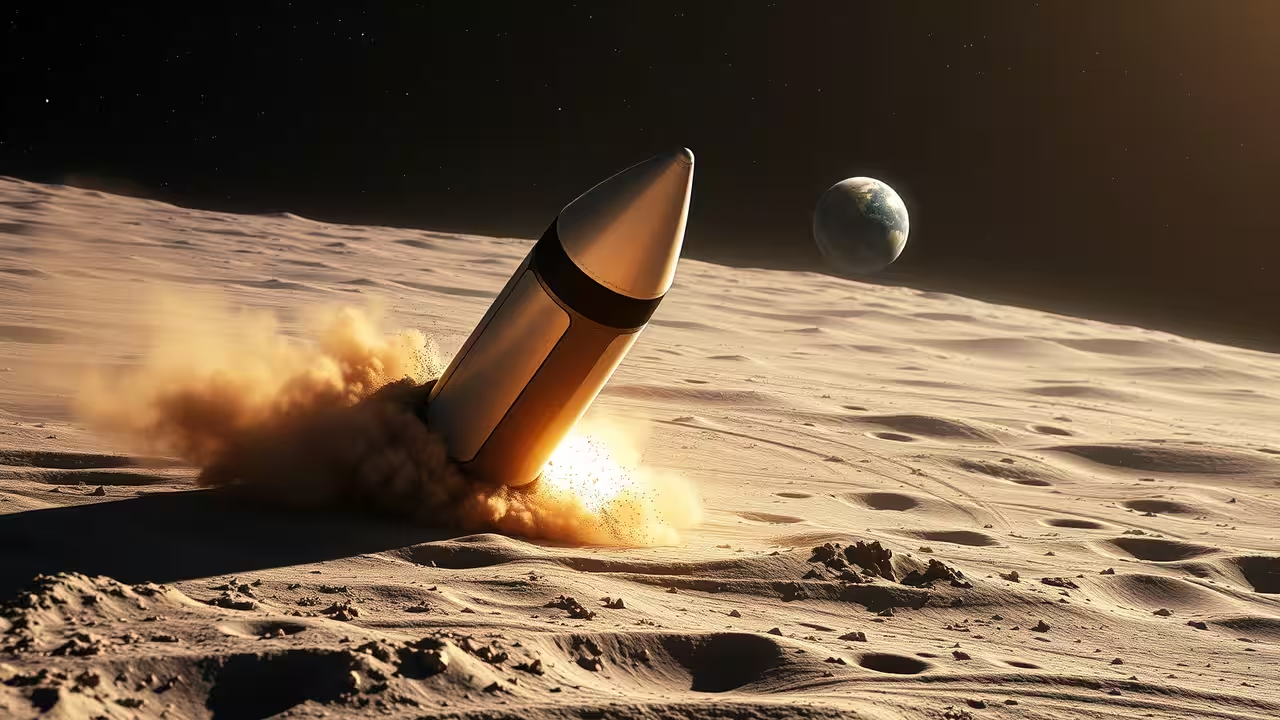
A rocket stage impact on the Moon has drawn attention after reports claimed that a piece of space hardware travelling at more than 8,000 km/h struck the lunar surface. The reported collision has renewed interest in the growing amount of human-made material travelling through space and the scientific value of studying impacts on the Moon.
According to the information circulating around the incident, the object was described as an upper-stage fragment associated with a SpaceX mission. However, the exact identification and origin of objects involved in lunar impacts can be difficult to establish, and such claims should be treated carefully until confirmed by authoritative tracking or space agencies.
The reported event has nevertheless highlighted an important area of space research: understanding how discarded rocket stages and other objects behave after completing their missions.
Rocket Stage Impact on the Moon Could Help Scientists Study Lunar Collisions
A rocket stage impact on the Moon can provide researchers with an opportunity to examine how artificial objects interact with the lunar surface. Unlike Earth, the Moon has virtually no atmosphere, meaning incoming objects do not experience the same atmospheric braking or burning that occurs during re-entry into Earth’s atmosphere.
At speeds of thousands of kilometres per hour, an impact can release enormous amounts of energy and excavate material from the lunar surface. Scientists can potentially study the resulting crater, ejecta and surrounding terrain to better understand the physics of high-speed collisions.
Lunar impacts are particularly interesting because the Moon has preserved evidence of impacts for billions of years. Its surface lacks the strong erosion processes found on Earth, allowing craters to remain visible for extremely long periods.
An artificial object hitting the Moon therefore provides researchers with an opportunity to compare a known or estimated impact event with other lunar craters. Data from spacecraft orbiting the Moon can potentially help scientists examine changes to the surface following such an event.
The impact of a rocket stage would not pose a direct danger to people on Earth. Once an object is on a lunar-impact trajectory, the collision occurs far away from Earth and does not represent the same type of risk as uncontrolled debris entering Earth’s atmosphere.
Why Space Debris and Lunar Missions Are Becoming a Bigger Concern
The reported Moon rocket impact also comes at a time when activity in space is increasing. Governments, private companies and international organisations are planning or conducting missions to the Moon, Mars and other destinations.
As the number of launches increases, more rocket stages, spacecraft components and other pieces of hardware are left in different orbits or trajectories. Most are carefully tracked, but some objects can become difficult to monitor over long periods, particularly when they travel beyond Earth’s immediate orbital environment.
Lunar exploration presents additional challenges. Objects sent toward the Moon can sometimes remain in space for years before eventually encountering the lunar surface or entering another orbit. Determining the origin of such objects can also be complicated when tracking information is incomplete.
The issue has encouraged greater discussion about responsible space operations and the need to maintain accurate records of spacecraft and rocket stages after launch.
For scientists, studying these impacts can also improve understanding of how future missions might interact with the lunar environment. This information could be useful as countries and private companies prepare for more frequent lunar landings, scientific missions and other activities on or around the Moon.
What Happens When a Rocket Stage Hits the Moon?
When a large object strikes the lunar surface at extremely high speed, the collision can create a crater and send material from the surface outward. The size and characteristics of the crater depend on factors such as the object’s mass, composition, impact speed and angle.
The Moon’s lack of a substantial atmosphere means that an incoming rocket stage would retain much of its velocity before reaching the surface. This makes lunar impacts different from many comparable events on Earth.
Scientists can use observations from lunar-orbiting spacecraft to investigate impact sites. Images taken before and after an event can potentially help researchers identify changes in the surface and estimate the size of the resulting crater.
Such studies can contribute to broader research into lunar geology, impact physics and space debris. They may also help scientists understand how future human-made objects could affect the lunar environment.
At the same time, determining exactly which rocket stage caused a particular impact is an important part of the investigation. Space agencies and independent researchers use orbital data, launch records and trajectory calculations to establish the likely origin of an object.
The reported SpaceX rocket stage impact on the Moon has once again highlighted the growing importance of tracking human-made objects in deep space. A high-speed lunar collision can provide valuable scientific information about impact dynamics and the Moon’s surface while also raising questions about responsible management of space hardware.
As lunar exploration expands, accurate tracking of rocket stages and spacecraft will become increasingly important. Researchers are likely to continue studying such events to improve knowledge of lunar impacts and support safer and more sustainable space exploration.
Follow SnippetX Media for the latest technology news, smartphone launches, gadget reviews, software updates, and breaking updates from the world of innovation.